
The Next American Century
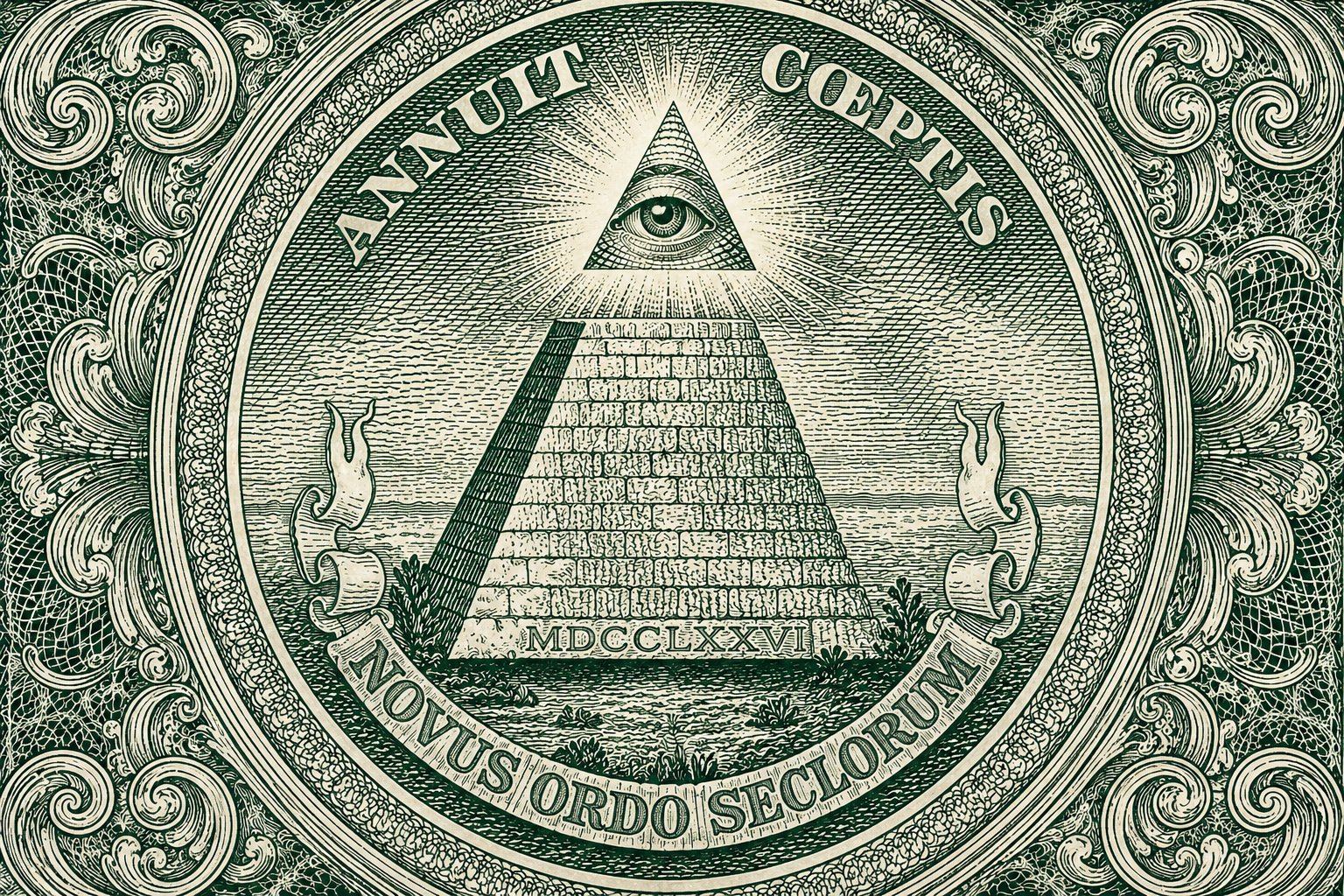
The All-Seeing Eye of Providence on the reverse side of the U.S. Dollar bill.
America’s 250th anniversary is a cause for celebration and an opportunity to reflect on where this great experiment might be headed.
Those questions inspired the creation of the Highland Institute for the Advancement of Humanity, not merely to study the future, but to help shape it by bringing together scientists, entrepreneurs, philosophers, artists, and spiritual leaders in pursuit of human flourishing. Over the years, I have explored the forces shaping our past, present, and possible future.
I generally strive to follow Abraham Lincoln’s example by keeping my columns under 300 words. But on the occasion of America’s 250th anniversary, I feel compelled to set brevity aside and share a broader vision of what I believe could become America’s second founding.
Over the years, I have written frequently about the concept of the Fourth Turning. Historians William Strauss and Neil Howe argue that Anglo-American history tends to unfold in roughly eighty-year cycles. Whether their theory ultimately proves correct or not, the pattern is intriguing.
Looking across American history, I notice four recurring conditions that often accompany periods of profound change: major geopolitical conflicts leading to war, disruptive technological innovation, economic displacement among educated populations, and rising antisemitism. All four conditions are present today. If history offers any guidance, we are approaching another hinge in history.
Human civilization has advanced through an accelerating succession of breakthroughs. Stone tools gave way to bronze, bronze to steel, fire to steam, steam to electricity, electricity to computing, and computing to artificial intelligence. Each breakthrough has shortened the time until the next. Human progress increasingly follows a logarithmic curve rather than a linear one.
While Newton revealed many of the governing laws of the three-dimensional physical world, Einstein transformed our understanding of space and time. Today’s atomic clocks, including those maintained at the National Institute of Standards and Technology (NIST) in Boulder, make the Global Positioning System so precise that it can often locate us within feet and, under ideal conditions, even inches.
I believe humanity’s next frontier will not be physical space, but the invisible realm explored by quantum physics—a world governed less by certainty than by probability. Quantum science is already reshaping computing, communications, sensing, cryptography, photonics, and materials science. We are only beginning to glimpse its possibilities.
Artificial intelligence is advancing at breathtaking speed. At the same time, brain-computer interfaces are moving from science fiction into reality. Companies such as Neuralink, Synchron, and Precision Neuroscience are developing technologies that allow the human brain to communicate directly with computers. Instead of carrying a smartphone in our pockets, future generations may interact with digital systems using only their thoughts.
Now imagine millions of people connected through artificial intelligence, quantum communications, brain-computer interfaces, and vast constellations of satellites. Like the breathtaking murmurations of birds or schools of fish that move as though sharing a single mind, humanity itself could become a living network.
As fascinated as I am by these technological advances, I remain even more interested in their spiritual implications.
The precision of the Egyptian pyramids continues to inspire awe thousands of years after they were built. Across many ancient traditions, the pineal gland, otherwise known as the “third eye,” has symbolized higher consciousness and spiritual insight. Whether understood literally or metaphorically, many civilizations throughout history have believed that human awareness can expand beyond ordinary perception.
In the King James Bible, Jesus taught, “If therefore thine eye be single, thy whole body shall be full of light” (Matthew 6:22). Many spiritual traditions interpret this passage as an invitation toward deeper awareness rather than merely physical sight.
In Becoming Supernatural, Dr. Joe Dispenza proposes that the pineal gland serves as a bridge between consciousness and what he calls the quantum field. His ideas remain outside mainstream neuroscience, yet they invite an intriguing question: What if the next great frontier of human evolution is not simply technological, but spiritual?
Perhaps humanity’s destiny is not to become gods, but to become more fully human by uniting extraordinary technological power with extraordinary wisdom, compassion, and self-mastery.
America has reinvented itself before. The Revolution established political liberty. The Civil War forged a more perfect Union. The crises of the twentieth century transformed the United States into the world’s leading economic and military power.
The next American century may demand something even greater.
Our second founding may not be defined by conquering new territory or building new institutions, but by expanding human consciousness itself. If America can lead the world in aligning technological genius with moral purpose, scientific discovery with spiritual growth, and individual liberty with collective flourishing, it can once again become history’s greatest experiment.
The first 250 years expanded the promise of freedom. The next century may determine whether humanity possesses the wisdom to wield its unprecedented power wisely.
If America’s first founding gave birth to a nation, perhaps its second founding can help give birth to a wiser civilization. That vision inspired the creation of the Highland Institute. Through what author Balaji Srinivasan calls the Network State, a voluntary community of 144,000 dedicated members united by shared values, curiosity, service, and the pursuit of human flourishing, we hope to help cultivate that future.
The next American century begins not with what we build, but with who we become.
Happy 250th Birthday, America.
— Sina.